Project Development
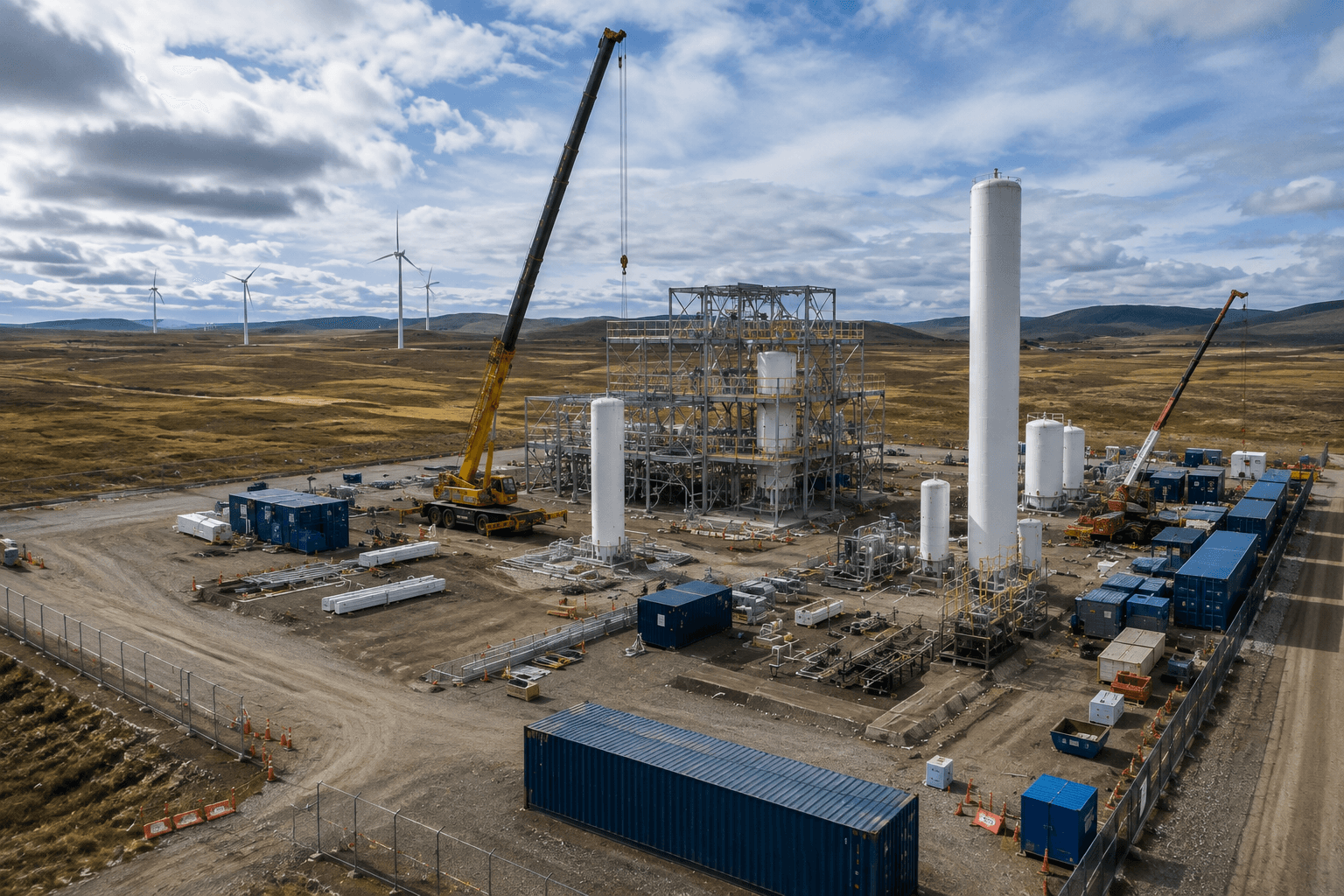
Construction Begins on Haru Oni e-Fuel Pilot Plant in Chile
Construction began on Chile’s Haru Oni pilot facility in September 2021, bringing together wind power, renewable hydrogen and carbon dioxide to produce synthetic fuel.
Siemens Energy, Porsche and their partners begin construction of an integrated wind-powered synthetic fuel facility in southern Chile
Construction officially began on the Haru Oni e-fuel pilot plant in Chile’s Magallanes region on 10 September 2021.
The project was developed to demonstrate an integrated production pathway using wind-generated electricity, renewable hydrogen and carbon dioxide to manufacture synthetic methanol and gasoline. Siemens Energy led the system integration, while Porsche participated as an industrial partner and intended fuel user.
Why Magallanes Was Selected
The Magallanes region in southern Chile is known for strong and consistent wind conditions.
These conditions were considered suitable for producing renewable electricity at high operating rates. The electricity would power electrolysers that split water into hydrogen and oxygen.
The renewable hydrogen would then be combined with carbon dioxide to produce synthetic methanol. A further conversion stage would transform the methanol into synthetic gasoline.
An Integrated Production Chain
Haru Oni was designed to combine several technologies at one location:
Wind-power generation
Water electrolysis
Renewable hydrogen production
Carbon dioxide capture
Methanol synthesis
Methanol-to-gasoline conversion
Fuel storage and testing
Integrating the entire process allowed the partners to study how the individual systems would operate together under real wind and production conditions.
The Role of Siemens Energy
Siemens Energy led the project’s technical integration and coordinated several of the plant’s main components.
The company described Haru Oni as an important demonstration of Power-to-X technology, in which renewable electricity is converted into transportable molecules and fuels.
The project also received approximately €8 million in support from Germany’s Federal Ministry for Economic Affairs and Energy as part of the country’s national hydrogen strategy.
Porsche’s Interest in E-Fuels
Porsche supported the project as part of its research into synthetic fuels for existing combustion engines.
The company planned to use the first fuel volumes in motorsport, vehicle testing and Porsche Experience Centres.
Porsche presented e-fuels as a potential complement to electric mobility, particularly for existing vehicles and applications where direct electrification may be difficult.
Planned Pilot Production
When construction began, the pilot plant was expected to start production during 2022.
The initial production target was approximately 130,000 litres of e-fuel per year. The pilot phase was intended to provide operational experience rather than immediately supply a large commercial market.
Future expansion plans discussed at the time projected much larger production volumes, although these depended on financing, permitting, renewable-power development and successful operation of the pilot facility.
Why the Construction Milestone Mattered
Before Haru Oni, many E-Fuel initiatives existed mainly as laboratory studies, engineering concepts or early project announcements.
Beginning physical construction demonstrated that the partners were moving toward an operating facility.
The project aimed to test:
Equipment integration
Production reliability
Fuel quality
Renewable-power variability
System efficiency
Maintenance requirements
Certification processes
International fuel logistics
Synthetic Fuel and Engine Compatibility
The planned synthetic gasoline was intended to have properties similar to conventional gasoline.
When a finished synthetic fuel meets the relevant technical specifications, it may potentially be used in compatible combustion engines and existing fuel infrastructure.
However, approval depends on the final composition, applicable standards, certification and engine requirements.
Environmental Performance
Synthetic fuel still releases carbon dioxide when it is combusted.
Its potential climate benefit depends on using renewable electricity and obtaining carbon from a non-fossil or recycled source. The complete environmental impact must therefore include:
Electricity generation
Hydrogen production
Carbon sourcing
Fuel conversion
Transport and distribution
Final engine efficiency
The project was designed to demonstrate technical feasibility, not to prove that every synthetic-fuel pathway would automatically be climate neutral.
What Happened After Construction Began
Haru Oni was later completed and officially opened on 20 December 2022.
At the opening ceremony, the first synthetic fuel produced at the site was used to refuel a Porsche 911. The facility’s pilot production target remained approximately 130,000 litres annually.
Key Takeaway
The start of Haru Oni’s construction in September 2021 marked an important step from e-fuel planning toward physical production infrastructure.
The project brought wind power, electrolysis, carbon sourcing and synthetic-fuel manufacturing together within one integrated facility and created a practical test platform for future Power-to-Liquid projects.

